



By Soothee® Team
Disclosure: Soothee® sells DIY miniature house and book nook kits, including the examples used below. We checked current exact-model product information, official product images, and Soothee®'s published support policies. This is a seller-written evidence checklist, not an independent review or a standardized hands-on test of every kit. Facts checked August 16, 2026.
Quick answer: Judge a DIY miniature kit by the evidence attached to the exact model, not by words such as “premium” or “high quality.” In a 10-minute listing audit, check exact-model images, material and part-preparation wording, consistent specifications, guidance and contents disclosures, realistic difficulty and time fields, lighting requirements, and the seller's support route. These signals reduce uncertainty; they do not prove perfect fit or long-term durability.
| Quality check | Stronger pre-purchase evidence | What that evidence still cannot prove |
|---|---|---|
| 1. Exact-model images | Full finished views, useful angles, close-ups, and lit/unlit views of the named model | Hidden joints, material grade, durability, box contents, or batch consistency |
| 2. Materials and part preparation | Model-specific material categories and literal wording such as pre-cut or colored | Cutting method, fit tolerance, perfect alignment, or finish durability |
| 3. Consistent specifications | Matching format, H × W × L, difficulty, time, age, contents, and power fields | That every builder or every production unit will perform identically |
| 4. Guidance and contents | Instruction language, guidance disclosure, named contents, and clearly excluded supplies | That every reader will find the manual clear or that no part can be missing |
| 5. Difficulty and project scope | A model-level difficulty label, estimated time range, and age guidance | Product quality, a guaranteed finish time, or individual ease |
| 6. Lighting and power | Exact lighting components, power source, battery requirement, and exclusions | Long-term LED or switch reliability |
| 7. Seller support | A visible contact route plus separate damaged-item and unopened-return terms | An automatic replacement, refund, free part, or approval in every case |

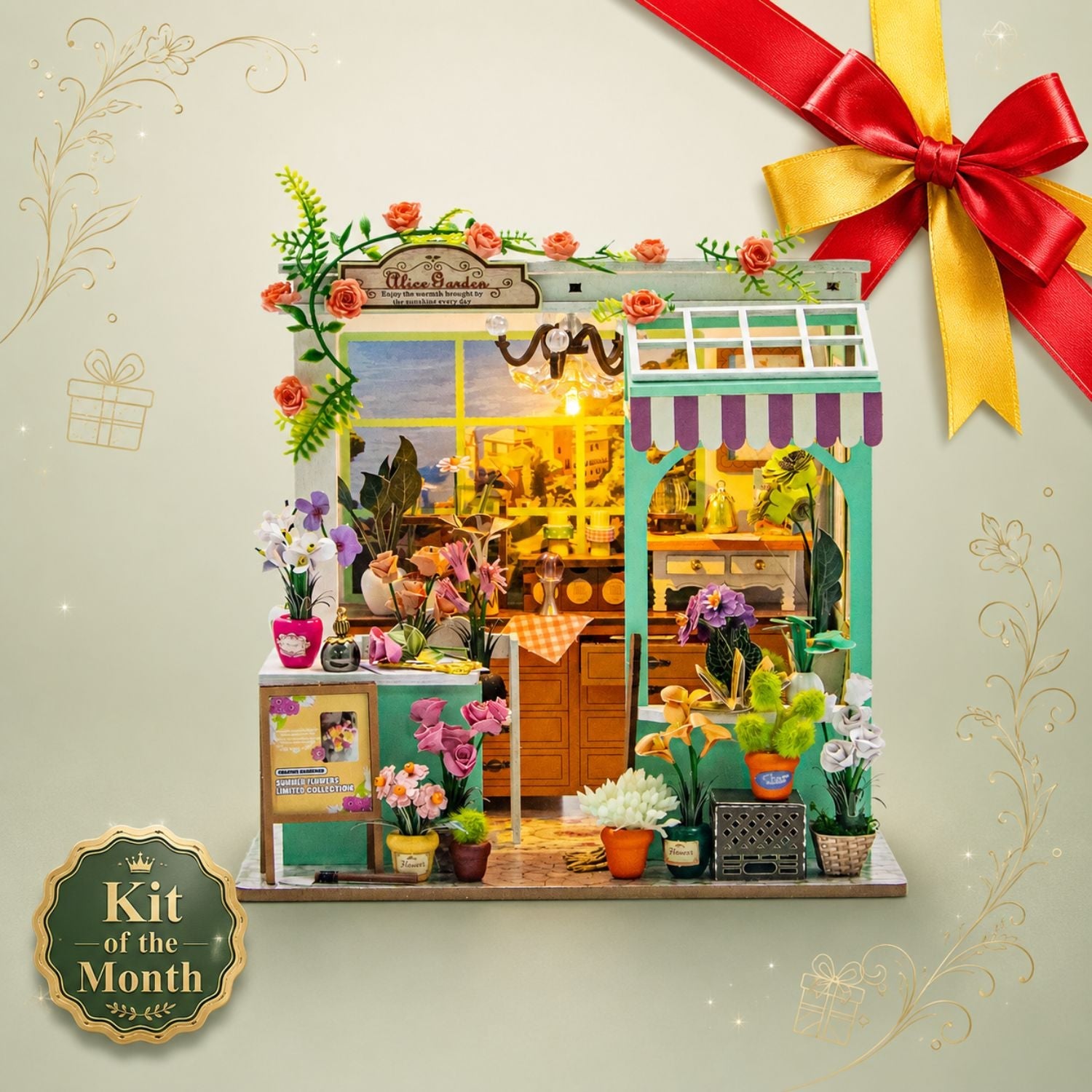
Featured Soothee® kit
Alice's Garden
A freestanding flower-shop miniature with warm LEDs and clear step-by-step guidance included.
Shop Alice's GardenWhat does “good quality” mean in a DIY miniature kit?
Quality is not one material, feature, price, or piece count. Buyers need accurate expectations, parts and guidance suited to the build, a finished appearance consistent with the model shown, and a contact route if something arrives wrong.
A listing can state dimensions, materials, contents, difficulty, time, power needs, instruction language, and policy terms. Without documented current-unit testing, it cannot certify fit consistency, durability, universal manual clarity, missing-part frequency, or long-term lighting reliability.
Use four evidence labels as you read:
- Explicit exact-model fact: written for the selected model, such as its H × W × L or included battery box.
- Image-visible observation: something the official image shows, such as an open front, layered facade, or illuminated finished scene.
- Specific hands-on report: a dated account from someone who built that exact model and describes a particular step or issue.
- Not established: a marketing adjective, an inference, a conflicting field, or a detail the seller does not disclose.
This evidence ladder is more useful than assigning an untested numerical quality score.
Can product photographs prove a miniature kit is good quality?
No. Exact-model photographs can show visible design and finish, but they cannot prove hidden construction or performance. Useful product media should still do more than present one distant beauty image.
Look for:
- a full front or three-quarter view of the exact finished model;
- another angle that clarifies its depth and physical form;
- close-ups of visible edges, layers, furniture, flowers, signs, or other small details;
- a lit and unlit view when lighting is part of the design; and
- a dimension or contents image that clearly belongs to the same model, when available.
A styled room image can help you judge decor fit. A close-up can help you judge whether you like the visible detail. Neither proves material thickness, hidden fit, structural durability, package completeness, or an identical result from every build. Treat the photograph as visual evidence, not a laboratory test or packing list.
How should you read material, “pre-cut,” and finish claims?
Read each term literally and stop where the disclosure stops. A named material category is more useful than “premium materials,” but even a specific category does not answer every quality question.
For example, wood, paper, acrylic, and LED components identifies a mixed-material kit, not the wood species, thickness, grade, coating, certification, or durability. 2.5 mm MDF answers type and thickness for one exact model, but not fit tolerance or long-term performance.
The same rule applies to prepared parts:
- Pre-cut means a named part is supplied beyond raw, uncut material. It does not prove laser cutting, a published tolerance, or perfect fit.
- Colored means the part is supplied with color already present. It does not identify the print or coating method or guarantee resistance to handling.
- Acrylic included does not automatically mean a protective or dust-proof front panel; the exact contents must identify the component.
If a material detail, certification, or cutting method is essential, ask for current documentation. An undisclosed detail is not proof of poor quality; it is simply not established.
Which specifications should agree before you buy?
The visible summary, specification panel, images, and variant should describe the same product. Contradictory information is a reason to pause and ask, not a reason to pick the most favorable number.
Check these fields together:
- Physical format: Is it a freestanding miniature house or a bookshelf-oriented book nook?
- Finished size: Are height, width, and length or depth labeled in a consistent order?
- Difficulty and time: Are both attached to this exact model rather than copied from a category-wide statement?
- Age guidance: Is a recommended age shown for the selected kit?
- Contents and extras: Does the named package list agree with any contents image?
- Lighting and power: Are the lighting components, power source, battery requirements, and exclusions consistent?
Do not use stale search snippets, cached sold-out text, or another seller's listing as the source of record. Use the current rendered exact-model page and ask the official seller to resolve a conflict. Written lighting details can confirm components and power needs, but they cannot prove long-term LED or switch reliability.
What instruction and contents disclosures reduce purchase risk?
The listing should state what guidance is included and distinguish package contents from buyer-supplied extras. “Everything you need” and “easy assembly” are weaker than model-specific facts.
Useful evidence includes the instruction language, named guide format, and sample pages when genuinely provided. A statement that clear step-by-step guidance is included does not prove a page count, diagram style, video tutorial, or tested success rate.
Confirm what the exact model names as included or excluded. Do not transfer a hammer, tweezers, glue, dust panel, or battery box from one model's list to another, and do not assume “kit” means every possible supply is in the box.

Do difficulty, build time, or piece count prove kit quality?
No. They describe project scope; they do not grade the product. A Beginner label can coexist with small components, and an Intermediate label does not mean inferior materials.
Treat level and time as model-specific planning information rather than guarantees. Piece count indicates components, not better detail, stronger materials, clearer instructions, or better value. For a first build or gift, compare level, time, age, and finished form together.
How should you use customer reviews as quality evidence?
Use reviews as supporting evidence, not as a substitute for exact product facts. The most useful review describes a current build of the same model and names an observable detail.
Look for reports that say whether the finished form matched current images, identify a straightforward or unclear step, describe how a damaged or apparently missing part was handled, and disclose whether the reviewer built or received the kit.
A star average, “cute,” “love it,” or a delivery-only comment cannot establish part fit or manual clarity. One complaint also cannot establish a batch-wide defect. Look for model-specific detail, current photographs, clear disclosure, and repeated patterns across independent reports where available.
What seller support should be visible before purchase?
A seller should publish a contact route and clear terms for product problems and returns. Read the detailed policy, not only a short “care-free returns” badge.
Soothee®'s current Refund and Return policy says to contact the team within 30 days for a defective, damaged, or incorrect item; photos or video may be requested. A US change-of-mind return also has a 30-day window, but requires original unopened packaging. Opened or used DIY kits are not accepted through that route, and the policy lists a return-shipping deduction.
If something appears missing, pause the build and use Soothee®'s official Contact Us page for review. The policy does not promise an automatic outcome or expressly guarantee a free missing part, so this article does not make that promise.
What does the checklist show for Alice's Garden?
Alice's Garden provides several exact-model evidence fields, but those fields should not be turned into a blanket quality verdict. The current Alice's Garden product page identifies it as a freestanding miniature house and currently states:
- main material categories of wood, paper, LED light, and acrylic;
- pre-cut and colored wooden pieces, miniature flowers, an English instruction guide, and LED strings;
- a Beginner label, a seller-estimated 2–5-hour build range, age guidance of 14+, exact finished dimensions, and two AAA batteries not included; and
- clear step-by-step guidance plus official finished and close-up images.
Those facts support transparency about the current model. They do not establish a wood species or grade, a cutting method, fit tolerance, finish durability, batch consistency, long-term LED reliability, or an independent test of the manual.
For the Alice-specific evidence and limits, use what Soothee® can verify about Alice's Garden quality after that exact guide is live. This category page remains the method; the Alice page remains the product-specific evidence record.
Which warning signs should make you pause before buying?
Pause when an important purchase fact is missing, contradictory, or supported only by an adjective. Ask the seller to clarify any requirement that matters to you.
Common warning signs include:
- “premium,” “precision,” “easy for everyone,” or “everything included” without model-specific evidence;
- only one distant finished image and no useful close-up or second angle;
- no labeled finished dimensions or an unclear height/width/depth order;
- a product title, images, summary, and specification panel that appear to describe different formats or versions;
- no model-level difficulty, time, age, contents, or power information;
- claims of perfect fit, durability, safety, or certification without documentation;
- reviews that discuss a different variation or never describe the build; and
- no visible official contact or detailed return route.
Proceed when the listing confirms your must-have facts and the remaining unknowns are acceptable. Pause or choose another product if you require named material grades, certifications, published tolerances, independent durability testing, or an opened-kit change-of-mind return and the seller does not provide those assurances.
Key takeaways
- Judge the exact model's evidence, not a brand adjective, high price, or piece count.
- Separate written facts, image-visible observations, hands-on reports, and details that are not established.
- Exact-model photos show appearance; they do not prove fit, durability, completeness, or batch consistency.
- Difficulty, build time, age, contents, guidance, and lighting should agree across the listing.
- Read the detailed support policy before ordering; no replacement or refund outcome is automatic.
- Alice's Garden provides useful seller disclosures, but Soothee® does not present them as independent proof of “premium quality.”
Want to apply the checklist to a current shortlist? Browse Soothee® Best Sellers, or start with the exact Alice's Garden miniature flower-shop kit.

